Regulatory Documents
- AASHTO T315 Determining the Rheological Properties of Asfhalt Binder Using a Dynamic Shear Rheometer (DSR)
- ASTM D7175 Standard Test Method for Determining the Rheological Properties of Asphalt Binder Using a Dynamic Shear Rheometer
- EN 14770 Bitumen and bituminous binders – Determination of complex shear modulus and phase angle – Dynamic Shear Rheometer (DSR)
- DSTU EN 14770:2019 Bitumen and Bituminous Binders. Determination of Complex Shear Modulus and Phase Angle using a Dynamic Shear Rheometer
These standards define the test procedure for bituminous binders using a Dynamic Shear Rheometer (DSR) to evaluate rheological properties. This method allows for the measurement of the complex shear modulus (|G*|) and the phase angle (δ) for original (unaged) bitumen, as well as after short-term (RTFOT) and long-term (PAV) aging.
Key Outcome:
- Complex Modulus G* [kPa]: Characterizes the stiffness and total resistance to deformation.
- Phase Angle δ [°]: Characterizes visco-elastic behavior; a smaller angle indicates higher elasticity.
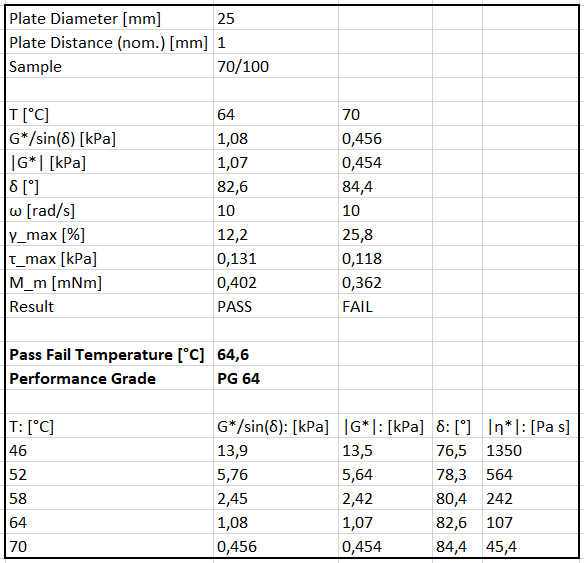
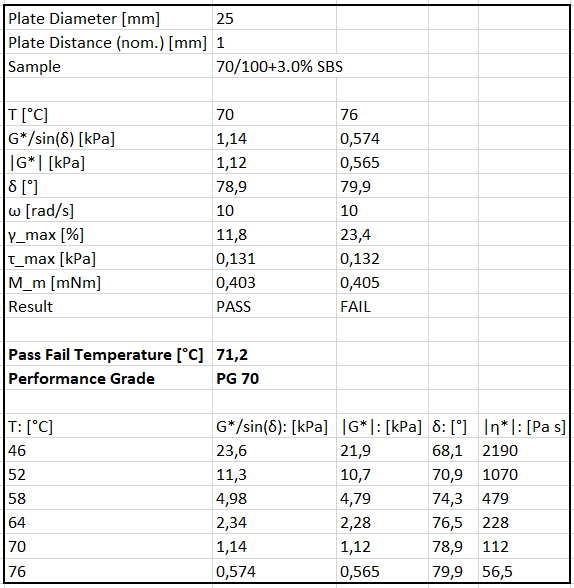
- Rutting Factor (G*/sin δ): Evaluated for unaged (≥ 1.0 kPa) and RTFOT binders (≥ 2.2 kPa).
- Fatigue Factor (G* · sin δ): Evaluated after PAV aging (≤ 5000 kPa).
Test Conditions
Temperature Range:
- for determining the rutting resistance parameterG*/sinδ – від 34 до 106 °C;
- for determining the fatigue cracking resistance parameter G*∗sinδ – from minus 5 до 40 °C.
Testing at a fixed temperature is possible.
Frequency: Standardly 10 rad/s (1.59 Hz).
Plate Diameter:
- for determining the rutting resistance parameter G*/sinδ – 25 мм;
- for determining the fatigue cracking resistance parameter G*∗sinδ – 8 мм.
Gap Between Plates:
- for determining the rutting resistance parameter G*/sinδ – 1 мм;
- for determining the fatigue cracking resistance parameter G*∗sinδ – 2 мм
Examples of Results
On the left is the test of unaged bitumen Orlen 70/100, which, according to the results obtained, corresponds to PG 64 under the Superpave system. On the right is Orlen 70/100 modified with a polymer (SBS), which corresponds to PG 70.